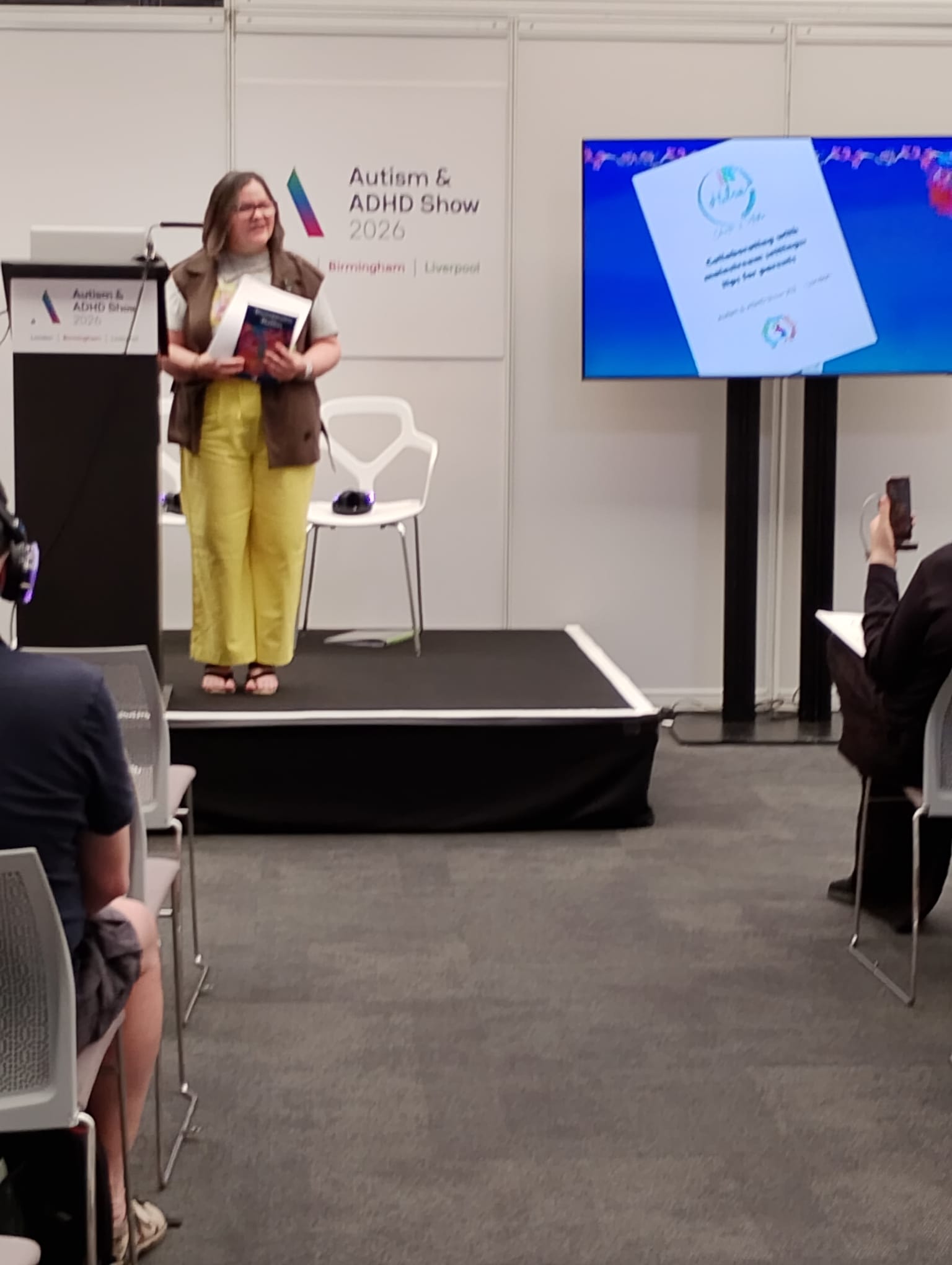
So this year I had a stand at the autism show and also had a speaking slot on the second day. I spoke about ways parents can support their neurodivergent children and young people in mainstream settings. I started by winding the room up a little, asking if I had put up the wrong presentation because the slides said 2025. Once everyone realised I was joking, I took them back to last year when I was actually in that same spot with my first two books.
At the time, many parents came to talk to me after my talk. They told me stories and shared their struggles and the barriers they faced supporting their children. Their stories were not too different from the parents of the young people I supported. My first two books were focused on the young people themselves. The first one was aimed at professionals, helping them better support neurodivergent young people, and the second one was for the young people, as someone had challenged me to do that.
After last year’s show, I made the decision to write a third book. Speaking to the parents here made me realise I had left a massive gap in the story. I had completely missed the impact the parents themselves were having on my work, their advocacy, their tenacity, and also their allyship with me. So I wrote ‘Unstoppable Mother’.
Why ‘Mother’, and not parent? I want to stress that I am not invalidating the parents who are not mothers. School communications usually say parent, guardian, or carer, but usually, it just means mum or mother, because she is almost always the one at the other end of the line. I needed to write a book for those mothers, and that is how ‘Unstoppable Mother’ was born.
I shared a little passage from that book with the audience, painting a picture of Mother navigating a train carriage while her toddler experienced a meltdown, surrounded by the invisible pressure of judgment from the wider public (Read Compliant Mother here).
From there, I moved into sharing some tips and advice that come from what I witnessed over years while being a professional in mainstream education and leading SEND support provision.
My very first tip is about what happens when you step into that role and stop being just a compliant parent. When you become this entity that I call by that proper name, Mother, with a capital M, you become this advocate parent, this warrior. This is a person who can be annoying to some, demanding to others, even irritating, but most certainly fierce, resilient, and stubborn. Your young person needs you to be that parent. It is very unlikely that in the current system barriers will be removed without you making a fuss. We just had this Government white paper coming out, and we know there is new legislation coming our way, and that there is a certain push for children and young people to be in mainstream education rather than in special education, which I welcome. I dream of inclusion. I work for inclusion. I left my home country some twenty-something years ago in pursuit of inclusion. But while we have many professionals who dream of inclusion, most times we work against our own frameworks: the evaluation system, the exam system, the grade system, the year group system, the qualification system, and all the systems in which inclusion needs to survive before having a chance to thrive. So, be unstoppable. Do not apologise for that. Do not feel bad about it. Do not let anyone even try to stop you.
My second tip is to think in terms of time-spanning. Think of the future, think of the past, think of the present. Do not let them blend into one permanent idea. Your child had needs, wishes, hopes, and fears when they were younger. They also have a future with its mysteries, but they live in the moment. Yesterday, your child may not have been able to do something, maybe they can do it today, perhaps tomorrow. Believe in the power of yet. Believe that your child is growing, and so are their abilities. If your child is autistic, that is permanent, they will be autistic forever. But their traits may evolve, they may morph into new traits, and they may change so radically that you do not even notice them anymore. Some behaviours that are considered autistic when they were younger may evolve into something that resembles neurotypical behaviour, and you may think they are less autistic. No, they are not. They are as autistic as before, but the behaviours grew up with them, and if your mind does not grow up with them, you may be stuck in the past with the version of autism from five years ago when you first learned your child was autistic.
My third tip is to meet other parents. Whether it is face to face in the playground, at birthday parties, at family gatherings, or in online support groups and advocacy groups, meet other mothers, and meet people who have been there. Share your knowledge with the new mother or the one recently presented with a diagnosis. You may be the parent of a neurodivergent teenager and meet someone whose toddler has just been diagnosed, who is facing so many of the same challenges you faced. Be that mother for them. But also meet parents whose children already flew the nest, or whose children never left and are today fully grown adults still living at home. Learn from all of them.
My final tip, which sits at the very heart of everything we discussed, is to look after yourself. Remember that when you learned your child was neurodivergent, at the same time that the new identity was laid upon your child, a new identity started in you as well. Always remember the oxygen mask principle in an aeroplane, that you have to put the mask on yourself first, and then help anyone around you. Look after yourself first. That is not selfish, that is generous. If you do not look after yourself, it may be heroic, you may be a martyr. But your child does not need a hero or a martyr. Your child needs a parent that will survive, and will be there even when they do not need you any longer. Be that parent, but also be there for yourself.
I finished by reminding everyone that my stand was E20 for the duration of the show, where I had neurodiversity awareness cards and copies of my books ready to sign. It was a wonderful opportunity to connect with so many passionate people.