
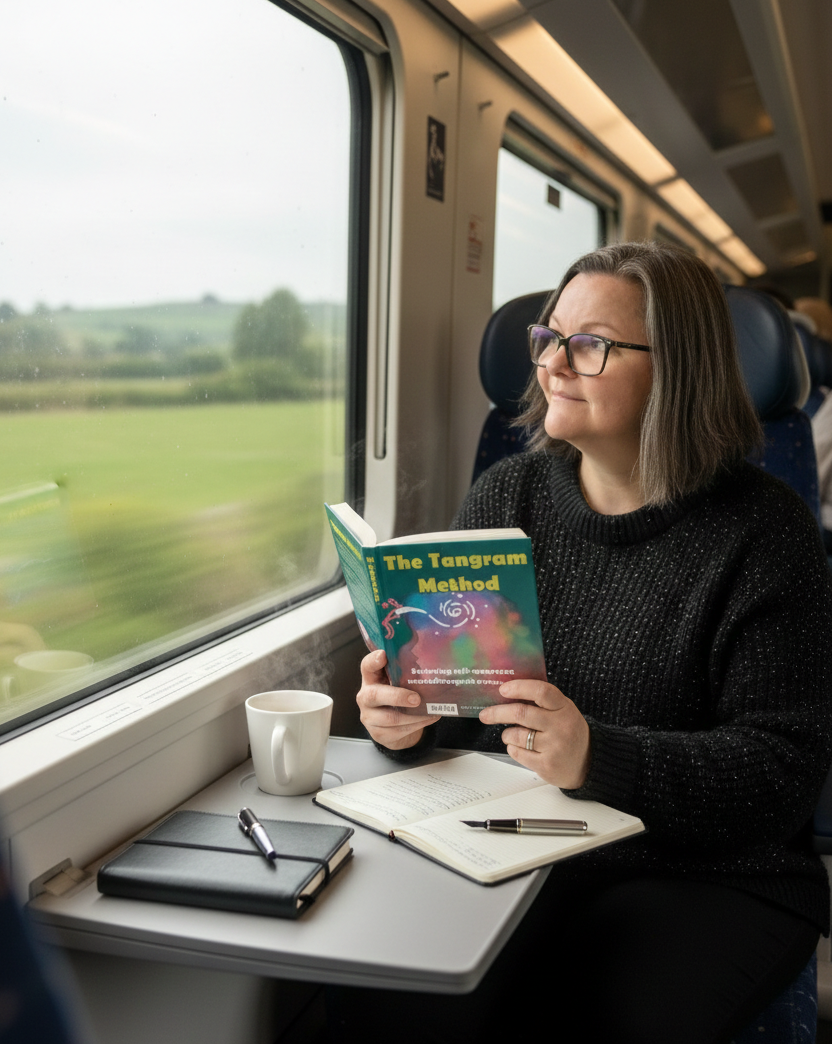
Have you ever noticed how most of the world is obsessed with forward motion? We are told to look ahead, to hit the next milestone, and to keep pace with a society that seems to be accelerating by the hour. But lately, I have been thinking about the wisdom of the backward-facing seat on a train.
When we sit facing backwards, we do not lose the journey; instead, we gain the perspective of what has just passed. We see the trees, the sheep in the fields, and the shifting sky for just a few seconds longer before they disappear from view. For those of us navigating the world of neurodivergence, this slower processing is not a deficit; it is a sanctuary.
The truth through hybrid fiction
I am currently immersed in the task of writing my new book, and I must confess that the process is as taxing as it is rewarding. I have spent weeks sitting in the metaphorical carriage of Chapter Two, crafting the stories of women who travel through life looking at the landscape from a different angle. But as I moved into the heart of the manuscript, the task has changed. I was no longer just writing about archetypes (my fictionalised charecters); alongside the creastive device I use to tell true storiew, I started to document the legacies of parents who have turned their parental defiance into systemic change. As usual, here I am crossing the boundaries of reporting reality and recreating it with art and creativity. I created my first set of fictionalised characters based on real people living a fictionalise story based on real events back in 2008, when I was writing my thesis. I realise now it has beclome my favourite device for storytelling. I foresee more projects coming out in that format. Time will tell.
The emotional labour of advocacy
Writing about advocacy is not always simple. Sometimes, the process of telling these stories is hurtful. Sometimes, the very people we hope will understand our vision are the ones who respond with a painful scepticism. This week, I have felt the sting of that disconnect. It has reminded me that writing about the ‘Unstoppable Mother’ is not just an intellectual exercise; it is an act of uncovering deep, often raw, emotional truths.
Winnicott’s Potential Space (O espaço do brincar de Winnicott)
It is in these moments of mixed emotions that I have to find my ‘potential space’. This is that quiet area where I can stop, put down the pen or close the laptop, and remember that the value of this work is not defined by the approval of others. Whether you are homeschooling, fighting for an inclusive sports club, or, like me, trying to find the right words to honour a legacy, remember this: your pace is the right pace. Even if you are the only one in the carriage sitting backwards, you are the one who truly sees the landscape.